
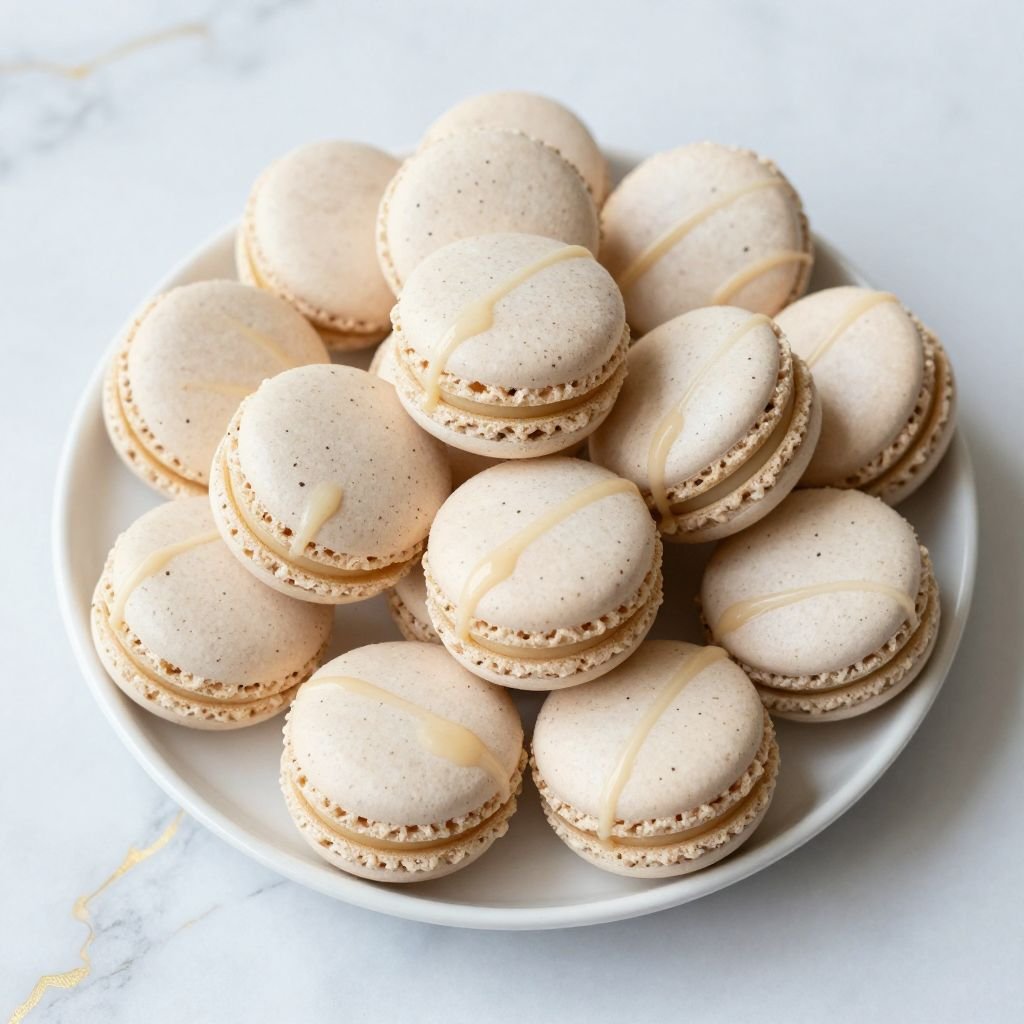
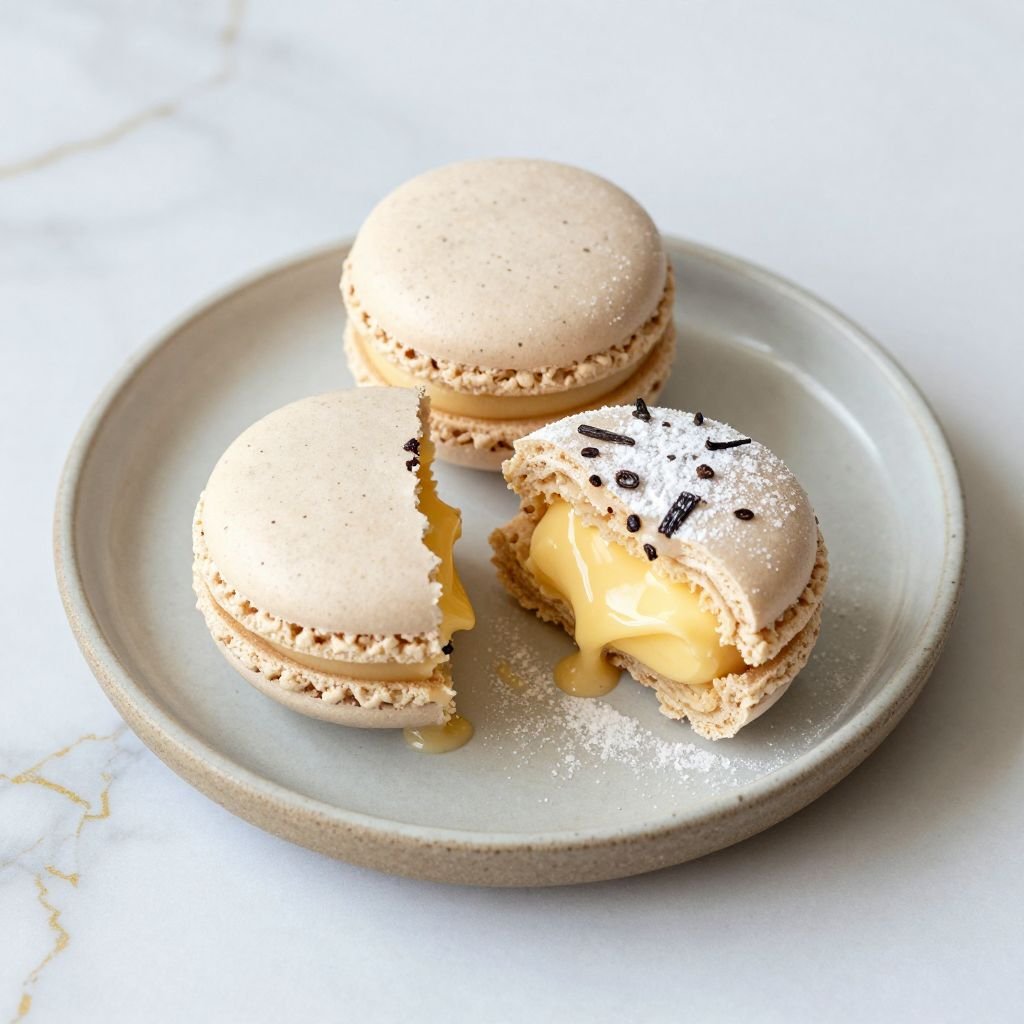
The moment you bite through that crisp, delicate shell into a cloud-like center that melts on your tongue, you’ll understand why macarons have captivated pastry lovers for centuries. These petite sandwich cookies, perfumed with real vanilla bean and boasting those signature ruffled “feet,” transform simple almond flour into edible luxury. What sets this version apart is the pure vanilla bean paste that creates natural speckles throughout the shells, eliminating artificial flavoring for an authentic French patisserie experience.
Why You’ll Love This Recipe
- Foolproof Italian meringue method stabilizes the batter, giving you a wider window to work and more consistent results than traditional French meringue
- Real vanilla bean paste creates visible specks and intense flavor that extracts simply can’t match
- Make the shells up to 5 days ahead and fill the morning of your event — perfect for stress-free entertaining
- Yields 24-30 sandwich cookies that look professionally made but cost a fraction of bakery prices
- One batch teaches you the technique to master endless flavor variations once you nail the basics
Pro Tips
- Age your egg whites by separating them 24-48 hours before baking and leaving them covered at room temperature — this reduces moisture for better structure
- Tap your baking sheet firmly on the counter 3-4 times after piping to release air bubbles, then use a toothpick to pop any remaining bubbles you see on the surface
- The “skin test” is crucial: after resting, gently touch a shell’s surface — if no batter sticks to your finger and it feels dry like paper, they’re ready to bake
- Oven temperature varies wildly between models — invest in an oven thermometer and bake a test batch of 4-6 shells to dial in your exact time and temp before committing the full batch
Classic French Vanilla Bean Macarons
Ingredients
Method
- Sift almond flour and powdered sugar together twice into a large bowl, discarding any large pieces. Set aside.
- Place 45 grams egg whites in the bowl of a stand mixer fitted with whisk attachment. Add cream of tartar and set aside.
- Combine granulated sugar and water in a small saucepan over medium heat. Stir until sugar dissolves, then stop stirring and let it cook until it reaches 240°F on a candy thermometer, about 5-7 minutes.
- When syrup reaches 230°F, start whipping the egg whites on medium speed until soft peaks form. Once syrup hits 240°F, remove from heat.
- With mixer on medium-low speed, carefully pour the hot syrup down the side of the bowl into the egg whites. Increase speed to high and whip until stiff, glossy peaks form and the bowl feels just warm to the touch, about 5-7 minutes. Add vanilla bean paste in the last 30 seconds.
- Add remaining 45 grams egg whites to the almond flour mixture and stir until a thick paste forms. Add one-third of the meringue and fold vigorously to lighten the mixture.
- Add remaining meringue and fold gently using a J-motion with a spatula, scraping from the bottom and folding over the top. Continue until batter flows in a thick ribbon and a figure-8 holds its shape for 10 seconds before disappearing — this takes 35-50 strokes.
- Transfer batter to a piping bag fitted with a 1/2-inch round tip. Pipe 1.5-inch circles onto parchment-lined baking sheets, spacing them 2 inches apart. Tap sheets firmly on the counter 3-4 times and pop any air bubbles with a toothpick.
- Let shells rest uncovered at room temperature for 30-60 minutes until they form a skin that doesn’t stick when gently touched. Preheat oven to 300°F during the last 15 minutes of resting.
- Bake one sheet at a time for 14-16 minutes, rotating halfway through. Shells are done when they don’t wiggle when gently touched and lift cleanly from the parchment. Cool completely on the baking sheet.
- For vanilla buttercream: Beat softened butter on high speed for 3 minutes until pale and fluffy. Add powdered sugar one cup at a time, beating well after each addition. Mix in vanilla bean paste, salt, and 2 tablespoons heavy cream. Beat on high for 2 minutes, adding more cream if needed for a pipeable consistency.
- Match shells in pairs by size. Pipe buttercream onto one shell of each pair and gently sandwich with the second shell. Refrigerate filled macarons for 24 hours before serving to allow the texture to mature.
Frequently Asked Questions
Why did my macarons crack on top?
Cracking usually means they didn’t develop a proper skin before baking or your oven temperature is too high. Let them rest until completely dry to the touch (30-60 minutes depending on humidity), and verify your oven is truly at 300°F with a thermometer.
Can I use vanilla extract instead of vanilla bean paste?
Yes, substitute 2 teaspoons pure vanilla extract for the bean paste, adding it to the meringue. You’ll lose the beautiful speckles but keep the flavor. Avoid imitation vanilla as it can taste artificial in such a delicate cookie.
How do I know when the macaronage is done?
The batter should flow like lava when you lift the spatula — it should fall in a thick ribbon and settle back into itself within 10-15 seconds. Undermixing leaves stiff peaks that won’t spread; overmixing creates flat, spread-out shells without feet.
What’s the best way to fill macarons without breaking them?
Use a piping bag with a small round tip and pipe a nickel-sized dollop of buttercream in the center of one shell. Gently press the second shell on top with a slight twist — the filling will spread to the edges without squishing out.
Storage & Serving
Store unfilled shells in an airtight container at room temperature for up to 5 days, or freeze for 3 months. Once filled, refrigerate for 24-48 hours to let the shells absorb moisture from the filling — this creates the perfect chewy texture. Serve at room temperature alongside espresso, champagne, or as an elegant finish to a dinner party. They also make stunning edible gifts when packaged in clear boxes tied with ribbon.
These vanilla bean beauties prove that with patience and precision, French pastry magic is absolutely within your reach.